Bible

Flatline Leadership

When the world thinks of leadership it usually has certain ideas in mind. Attached to these ideas are words powerful with imagery and meaning.

For example think of how invested the world seems to be in the following words as they apply to leadership:

office

power

status

prestige

appearance

performance

However, when we consider Jesus, these words fail to describe the Lord’s leadership qualities. In fact, he seems to defy them and steer an opposite direction. Consider then, for a few moments, what we learn about Jesus and the ideas these words bring to mind:
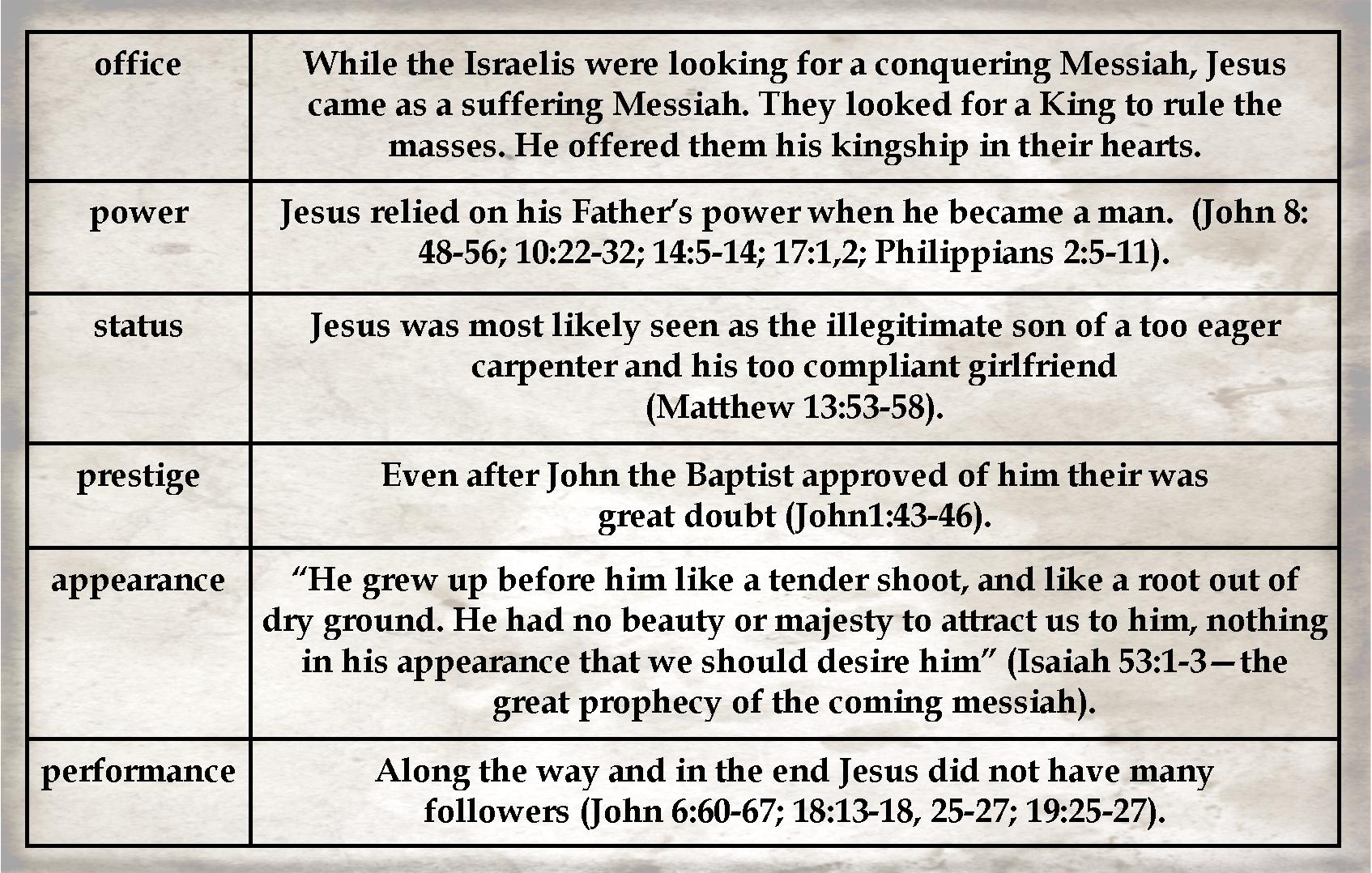
In fact, when we think of Jesus and how he led, we need to think in completely different terms. Rather than being invested in office, power, status, prestige, appearance, or performance, Jesus was invested in words like ransom, service, and love.

In Mark 10:45, these words of our Lord Jesus were recorded: “For even the Son of Man did not come to be served, but to serve, and to give his life as a ransom for many.” Now think about that for a few moments…and ask yourself a question, “How would Jesus lead people out of darkness, away from Satan, sin, and self, and into the eternal arms of his Father?” He would do so by giving himself as a ransom — a payment for our sin, an eternal credit to cover our egregious debits. He would do so by not asking for what was rightfully his to possess — our servitude —  but instead by serving.

In Philippians 2:5-8, this great truth was recorded by the Apostle Paul:  “Your attitude should be the same as that of Christ Jesus: Who, being in very nature God, did not consider equality with God something to be grasped, but made himself nothing, taking the very nature of a servant, being made in human likeness. And being found in appearance as a man, he humbled himself and became obedient to death—even death on a cross.” Now notice Paul did not say Jesus gave up his deity. Instead, he wrote about what Jesus took upon himself: humanity, servant-hood, humility, and obedience to sacrifice. While he did not relinquish his deity, he did give up his turf. It was not important that he be able to hold tight to his heavenly glory. As a result, just as we saw in the Gospel of Mark, he came to lead us into salvation through service.

In John 15:9-17, we read: “As the Father has loved me, so have I loved you. Now remain in my love. If you obey my commands, you will remain in my love, just as I have obeyed my Father’s commands and remain in his love. I have told you this so that my joy may be in you and that your joy may be complete. My command is this: Love each other as I have loved you. Greater love has no one than this, that he lay down his life for his friends. You are my friends if you do what I command. I no longer call you servants, because a servant does not know his master’s business. Instead, I have called you friends, for everything that I learned from my Father I have made known to you. You did not choose me, but I chose you and appointed you to go and bear fruit—fruit that will last. Then the Father will give you whatever you ask in my name. This is my command: Love each other.”  Love is crucial to our understanding of our Savior’s leadership style. It does not mean, necessarily, that we give into the cries or demands of others. It does not mean that we enable the sin of others by glossing over them and refer to ourselves as having loved unconditionally. Instead, it means that the one loving must always do what is best for the one being loved.

A quick recap of these keys words, then, might give us the following:

Jesus was motivated by love

and mobilized to ransom

which led to his ministry of service.

We can see this in Jesus by referencing some modern day leadership concepts and comparing them to his life. For example, consider the four leadership styles usually referred to as Dominant, Influential, Steadfast, and Conscientious — sometimes referred to as the Lion, the Otter, the Golden Retriever, and the Beaver, or as the Driver, the Promoter, the Supporter, and the Analyzer.

These four different leadership styles are generally seen in various capacities in everyone, but individually seen as dominant in different people. In other words, while everyone will possess some of each style, individuals will be predominantly one or another. The following chart shows how it works…

Jesus, however, shatters the boundaries between each style. In fact, while each of us will show differences on each scale, Jesus will flat-line high (score the same and score high) on all of them.

Why? The answer is not so difficult: since Jesus is motivated by love, he mobilizes himself as a ransom, creating on our behalf a ministry of service. This requires that he be the complete person and, of course, he is.

●   At times Jesus leads as a Driver.

Like a Lion he enters the temple and drives back the evil. Notice Matthew 21:12-17:

“Jesus entered the temple area and drove out all who were buying and selling there. He overturned the tables of the money changers and the benches of those selling doves. ‘It is written,’ he said to them,  ”my house will be called a house of prayer,” but you are making it a “den of robbers.” The blind and the lame came to him at the temple, and he healed them.

But when the chief priests and the teachers of the law saw the wonderful things he did and the children shouting in the temple area, ‘Hosanna to the Son of David,’ they were indignant. ‘Do you hear what these children are saying?’ they asked him.

‘Yes,’ replied Jesus, ‘have you never read,’ ” From the lips of children and infants you have ordained praise?’ And he left them and went out of the city to Bethany, where he spent the night.”

He utterly, completely, dominantly takes charge.

●   At other times Jesus leads as a Promoter.

Like a true team builder he says to his closest disciples, “I no longer call you servants, because a servant does not know his master’s business. Instead, I have called you friends, for everything that I learned from my Father I have made known to you” (John 15:15).

He expressively, socially, influentially builds trust.

●   At yet other times Jesus leads as a Supporter.

Like a tender-hearted, empathetic care giver he touches the leper and says, “I am willing, be clean” (Mark 1:40-42).

He compassionately, amicably, steadfastly seeks to serve.

●   Still, at other times Jesus leads as an Analyzer.

Like an organized, detailed teacher and manager he assigns ministry to his disciples, sending them out two by two, and says, “Take nothing for the journey except a staff—no bread, no bag, no money in your belts. Wear sandals but not an extra tunic. Whenever you enter a house, stay there until you leave that town. And if any place will not welcome you or listen to you, shake the dust off your feet when you leave, as a testimony against them” (Mark 6:8-11).

He compliantly, conscientiously, objectively, administratively outlines the tasks.

So, what do we learn from all of this?

1.   We learn that in the end Christ-like leadership is all about…

…becoming a ransom…being willing to sacrifice on behalf of others.

…becoming a servant…being willing to do unto others even what others are not willing to do for us.

…becoming a vehicle for love…being willing to do whatever is best for others.

2.    We learn that if we are to become like Jesus we will need to overcome our flesh tendencies so that we can lead appropriately in various situations. Rather than falling back into our typical grid — whether it is being a lion, an otter, a golden retriever, or a beaver, or some other model — we must learn to be more like Jesus. In fact, this is precisely what the Bible tells us God is doing when he allows us to face trials, tribulations, and tests. In Romans 8:28,29, the Apostle Paul wrote, “And we know that in all things God works for the good of those who love him,whohave been called according to his purpose. For those God foreknew he also predestined to be conformed to the likeness of his Son, that he might be the firstborn among many brothers.”

3.    We also must learn that, like Jesus, being accomplished in many areas is a spiritual work. Jesus flat-lines high on all leadership traits because of his nature and his willingness. What dangers do we risk as we start to flat-line?

One danger is of our own making. If we flat-line in the flesh, rather than through the filling of the Holy Spirit, the Lordship of Christ, and the sovereignty of the Father, we are not becoming Christ-like leaders, but chameleon leaders.

Another danger comes from others. Even if we flat-line through the Spirit, others may perceive us as chameleon-like. They may attribute our situational abilities as hypocrisy. They may accuse us of being two-faced and manipulative. They may argue that we are attempting to be one thing to one person and another thing to another person just to win some kind of personal advantage. What do we do then? Like Jesus, we recognize the judgmental inclinations in people and press ahead with humble and contrite hearts.

4.    We must likewise learn to think outside our own grid. Others are not like us. They do not always share the same personality. They do not have the same likes or dislikes. Their backgrounds are completely different from ours. Like us, they are unique. As we lead people, we need to understand how God has designed each person. As we learn to think through their grid, we become far more capable of sacrificing on their behalf through loving acts of servanthood.

5.    Finally, we must learn to appreciate that different circumstances call for different leadership styles. Sometimes we teach. Sometimes we encourage. Sometimes we remain silent. Sometimes we correct and rebuke. Sometimes…

Standard
Bible, Life's Moments

Theological Practice Demands Theological Foundation

Have you ever heard another person say, “Don’t give me theology, I just need something practical?

Far too often in the Christian community we hear believers offer this sentiment as though the great foundational truths of our faith have little to do with our lives beyond our initial salvation…but, (please excuse the poor English) this just ain’t so. What we believe has everything to do with how we act. How deeply we believe determines how deeply our actions will conform to our belief. For example, if we simply pay lip-service to the doctrines of God’s omniscience (all-knowing) and omnipresence (everywhere present), we will probably never give much thought to what God is thinking about us when we’re about to engage in sin. However, if these doctrines are paramount not only in our minds, but our hearts as well, then being keenly aware of God’s presence and all-knowing awareness of our actions will more than likely cause us to hesitate and even refrain from engaging in the sin.

Thus sound biblical theology is basic to sound Christian living.  True, we will not always act with integrity regarding our biblical foundations, but it is even more true we will fail to live up to biblical expectations if we are not biblically informed. This is really true in our relationships…and really, really true concerning our most special relationships. We can see this with a brief look at the Apostle Paul’s instructions on the family found in Colossians 3:18-21).

Here’s what he wrote:

18Wives, submit to your husbands, as is fitting in the Lord.

19Husbands, love your wives and do not be harsh with them.

20Children, obey your parents in everything, for this pleases the Lord.

21Fathers, do not embitter your children, or they will become discouraged.

Now, at first glance, that all seems really straight forward. However, to jump into Paul’s explanation of a Christ-centered home, in Col. 3:18-21, without first considering the overall intent of his letter causes us to miss crucial theology concerning the Lord Jesus Christ that reflects directly on a believer’s ability to follow through on the commands found in Colossians 3:18-21.  So, let’s back up a little…

The Colossians had come under a set of false teachings that taught, among other things, that Jesus was not sufficient for the complete work of redemption. Much like present day Christians, the Colossians were being lured into a “Jesus plus something” mentality. In chapter two of Colossians (2:16-19) some of those things were mentioned:

eating rituals

religious festivals

false humility

worshipping angels

special knowledge

The Apostle would have none of it. It is why he went to great lengths (Colossians 1:15 – 2:15, 20-23) to show that Jesus was not only sufficient to save them from their sins, but to save them from their old habits and to transform them into that for which God had redeemed them. Therefore, the great theme of his letter to them was simple:

Christian maturity (the full work of salvation) is based solely upon the sufficiency of Jesus Christ.

So how does this kind of doctrine about the person and work of Jesus Christ impact our abilities to be submissive wives, loving husbands, obedient children, and instructive parents? Or, if we want to get personal we might ask, “When was the last time your knowledge about Jesus changed your behavior?” Most people would answer, “Uhhhhh, well, ummmm, I don’t really remember.” In the end, we cannot hope to be godly spouses, parents, or children if we cannot connect the foundational truths necessary for following our Savior to the transformational attitudes necessary to produce right action. Therefore, by necessity, the first part of Colossians (the theological foundation) informs and empowers the second part of Colossians (the theological practice).

The figure below illustrates the point:

The most practical, pragmatic, helpful, insightful advice we can offer others is this: the best psychology is biblical theology. You cannot do until you know.

Standard
Bible

IShare, YouShare, WeAll Share, because HeShares

This is just a very cool video. You can download it at ishareministries.com. Load it on your ipod or other device. Pray for opportunities. When the opportunities come, seize them with love and respect.

Colossians 4:2-6

Continue steadfastly in prayer, being watchful in it with thanksgiving. At the same time, pray also for us, that God may open to us a door for the word, to declare the mystery of Christ, on account of which I am in prison— that I may make it clear, which is how I ought to speak.  Walk in wisdom toward outsiders, making the best use of the time. Let your speech always be gracious, seasoned with salt, so that you may know how you ought to answer each person.

Standard
Bible

Biblical is the New Radical

I have searched high and low to find someone else who believes the Church of America has grown woefully inadequate to its calling. It would seem that rather than bringing glory and honor to God (Eph. 1), the American Church has become exceptionally self-centered. Yet now, from time to time, I glimpse bright spots…glimmers of hope that we might return to our high calling. David Platt, in his new book, Radical, creates one of those bright spots by writing about something he calls radical, but is really something biblical.

His basic premise is that American Christians have exchanged God’s glory and God’s gospel for the American Dream. I believe the evidence supports his premise. So, as I turned every page of this biblical–not so much radical–gift to both the church and the unchurched,  I found my hopes being boosted. Here was a pastor of a very large church voicing anxieties like these:

“Soon I realized I was on a collision course with an American church culture where success is defined by bigger crowds, bigger budgets, and bigger buildings. I was now confronted with a startling reality: Jesus actually spurned the things that my church culture said were most important. So what was I to do? I found myself with two big questions. The first was simple. Was I going to believe Jesus? Was I going to embrace Jesus even though he said radical things that drove the crowds away? The second question was more challenging. Was I going to obey Jesus? My biggest fear, even now, is that I will hear Jesus’ words and walk away, content to settle for less than radical obedience to him. In other words, my biggest fear is that I will do exactly what most people did when they encountered Jesus in the first century” (Radical ch. 1).

Amazing! It is amazing not because a megachurch pastor is willing to risk what our American church culture values, but that it has become necessary for a humble pastor to refer to biblical truth and biblical obedience as radical. In fact, maybe “amazing” was the wrong word for me to use at the beginning of this paragraph. Perhaps sad or tragic would have served better.

Pastor Platt rounded out his challenge by discussing such “radical” needs as actually being hungry for the word of God, depending on the Holy Spirit, extending God’s grace to the lost, seriously asking ourselves “How much is too much materialism,” shunning titles, position, and prestige for the sake of becoming servants, and realizing that evangelism/missions is not an option. And again I found myself thinking, “Amazing. Biblical has become the new radical.”

Finally, Pastor Platt’s book should not be considered a one time read. It should become a companion to an ever present attempt to implement the purposes and plans of God found in the Bible. While that may be a radical notion to God’s people living in 21st century U.S.A., it is hardly a radical idea in the heart and mind of God the Father, Son, and Holy Spirit.

Note: “I received this book for free from WaterBrook Multnomah Publishing Group for this review.” You can download and read Chapter One at http://www.radicalthebook.com/resources.html.

Standard
Bible, Life's Moments

Judas and Lady Gaga

While I can not say that I fully understand all that Lady Gaga wants to say through her new single, Judas (coming out on her up-coming album Born This Way), there is a part of the song that moves me to tears. Toward the end of the song, she sings

“I wanna love you,
But something’s pulling me away from you
Jesus is my virtue,
And Judas is the demon I cling to, I cling to.”
 
Maybe the Catholic Church is right when they suggest she is just being disrespectful (http://newyork.cbslocal.com/2011/04/19/lady-gagas-new-song-judas-causes-holy-week-uproar/).  However, I am inclined toward grace, so I hope what she meant when she penned these words is something like this: “Oh, Jesus, I know you are the last, best hope. I know you are the one I need. Still, something in me moves me to cling to Judas instead.” If so, Lady Gaga is in the company of many: partially blind people catching a glimpse of heaven while clinging tightly to the thrills of hell.
 
Either way, I am reminded of what our Lord Jesus said about the people of Jerusalem as he made his way to the Holy City (Luke 13:34):
 
“Jerusalem, Jerusalem, you who kill the prophets and stone those sent to you, how often I have longed to gather your children together, as a hen gathers her chicks under her wings, and you were not willing.”
 
We all know that the level of hostility generated by the good citizens of Jerusalem toward the Savior rises far above that offered by Lady Gaga. We also know Jesus knew what they were about to do to him. Still the Lord’s heart was moved to compassion on their behalf. He is thinking no differently where Lady Gaga is concerned. He loves her. His Father loves her. The Holy Spirit loves her.  In fact, the Apostle Peter, inspired by the Holy Spirit wrote (2 Peter 3:9),
 
“The Lord is not slow to fulfill his promise as some count slowness, but is patient toward you, not wishing that any should perish, but that all should reach repentance.”
 
And just so his intentions were clear, he followed that with this (2 Peter 3:10),
 
“But the day of the Lord will come like a thief, and then the heavens will pass away with a roar, and the heavenly bodies will be burned up and dissolved, and the earth and the works that are done on it will be exposed.”
 
Together they mean one thing: while the Lord is very patient as he awaits people to flee the kingdom of darkness and run into his waiting arms, his patience will not last forever. It will not last forever in the cosmic sense and it will not last forever in the cause of Christ for one lost person. Like Lady Gaga, there are precious souls all around us. Let’s stop complaining about their antics and attitudes and start leading them via love and service to the Messiah.
Standard